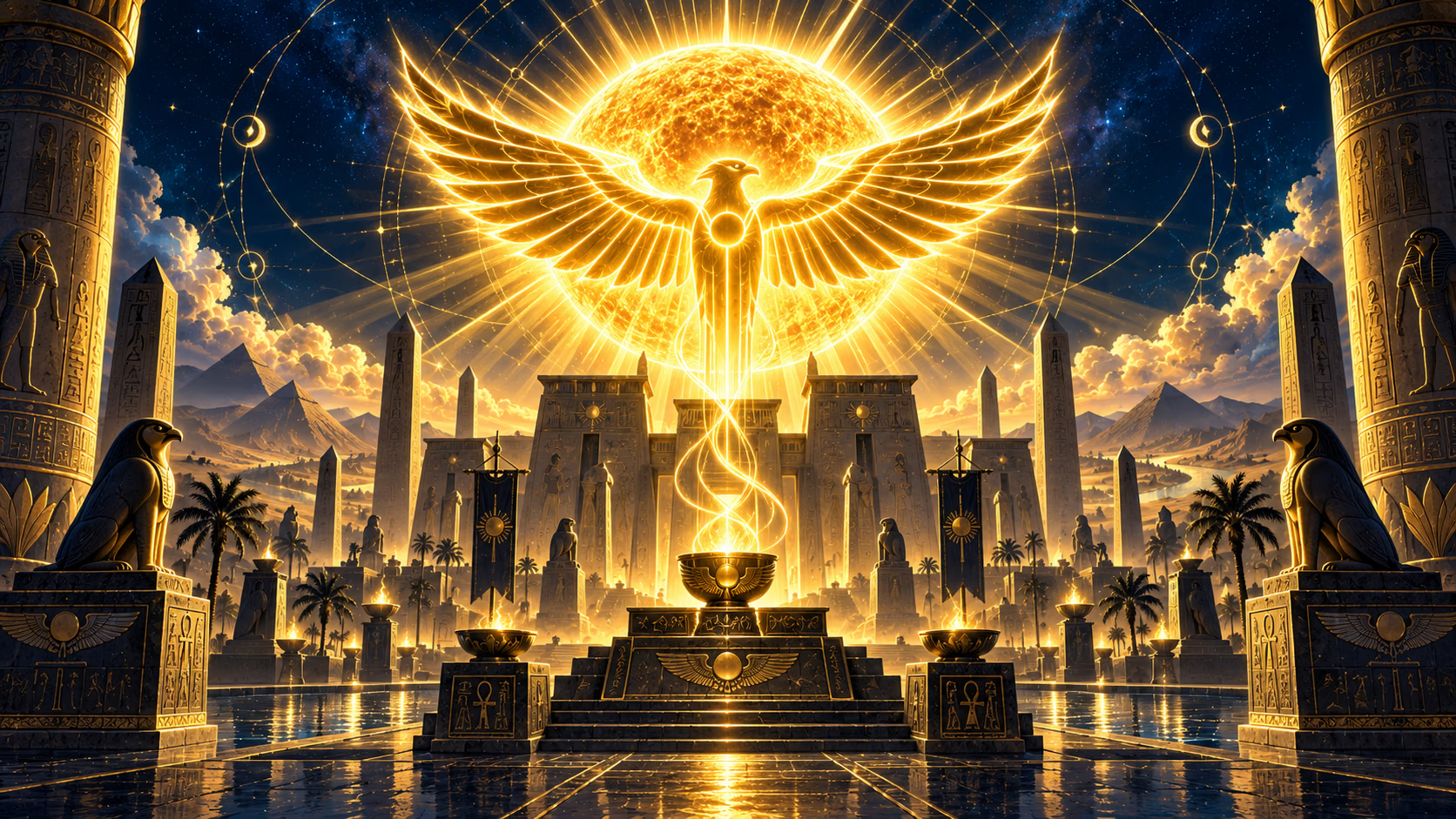
Mặt trời vàng rực phía trên ngôi đền Ai Cập cổ đại, các luồng sáng tạo thành hình chim thần trừu tượng, tượng trưng cho quyền năng của The Winged Dragon of Ra.
DuelIndex Editorial

The Winged Dragon of Ra: Solar Divinity and the Price of Power

Understanding Life Point mechanics, divine transformations, and the evolving design of an Egyptian God Card

The Winged Dragon of Ra represents a distinctive approach to monster design in Yu-Gi-Oh!: enormous offensive potential tied directly to the controller's survival resources. Its demanding Summoning requirements and Life Point costs create substantial strategic risks. Sphere Mode, Immortal Phoenix, and dedicated support cards expand Ra into a broader system of deployment, protection, and transformation. This article examines its strengths, limitations, and design legacy while distinguishing narrative power, theoretical potential, and practical effectiveness.

← Articles
Among the three Egyptian God Cards, The Winged Dragon of Ra has a particularly distinctive identity: its power is directly connected to the controller's survival resources. By converting almost all remaining Life Points into ATK and DEF, a player can transform a monster without fixed printed statistics into an enormous offensive threat. That potential comes with demanding Summoning requirements, significant resource expenditure, and considerable vulnerability. As Ra's support system expanded, its identity grew beyond the original monster to encompass Sphere Mode, Immortal Phoenix, and cards designed to connect their mechanics. Understanding Ra therefore requires examining not only what it can accomplish, but also what a player must sacrifice to make that power available.

Cards featured in this article

The Winged Dragon of Ra: From Solar Symbolism to Expectations of Power

The Winged Dragon of Ra belongs to the Egyptian God Cards alongside Slifer the Sky Dragon and Obelisk the Tormentor. All three are DIVINE Divine-Beast monsters whose identities draw upon the concept of extraordinary divine entities.

Ra is particularly associated with solar imagery, vitality, and destructive power. This representation naturally creates expectations that it should possess exceptional abilities. However, narrative importance does not automatically translate into practical effectiveness within the official card game.

Unlike Obelisk the Tormentor, whose printed ATK and DEF are 4000, The Winged Dragon of Ra does not begin with fixed printed statistics in the same way. Its strength depends on card effects and the resources invested by its controller.

This distinction establishes the central design question: Ra represents a god capable of reaching tremendous power through a deliberate exchange, rather than a monster that consistently arrives with a predetermined level of strength. A meaningful examination therefore considers four separate dimensions: accessibility, resource cost, immediate impact on the field, and the ability to convert an advantage into victory. Maximum ATK alone cannot describe the complete value of the card.

Cards mentioned

From Narrative Divinity to Playable Card Mechanics

Divine characters in manga and anime can be represented through dialogue, dramatic events, visual effects, and rules established within the story. Turning those characters into playable cards requires their abilities to be expressed through specific activation conditions, costs, and outcomes.

The Winged Dragon of Ra demonstrates this transformation clearly. Rather than possessing unrestricted divine authority, its playable form requires three Tributes for its Normal Summon and cannot be Special Summoned through ordinary methods. In exchange, its Normal Summon cannot be negated, and other cards and effects cannot be activated when it is Normal Summoned, as specified by its card text.

Its Life Point conversion mechanic represents the idea of transferring the controller's vitality into divine power. Its additional ability to pay 1000 LP and destroy a targeted monster provides another expression of destructive force.

These features nevertheless have defined boundaries. Protection surrounding the Normal Summon does not establish universal immunity after Ra enters the field. Likewise, abilities portrayed in the original narrative do not automatically become legal effects in the physical card game.

Understanding this distinction is essential when discussing Ra's reputation. Narrative power and mechanical effectiveness operate under different systems, even when both are intended to represent the same divine character.

Cards mentioned
Mechanic explained

From narrative symbolism to conditional card effects

The printed effect translates narrative power into specific actions, costs and limits.

  1. 1

    Summoning

    Ra requires three Tributes for a Normal Summon. Its Normal Summon cannot be negated, but that protection is not permanent immunity.

Takeaway: Use the actual card text to explain Ra; do not turn its narrative divinity into universal immunity.

Core Mechanics: Life Points, ATK/DEF, and Resource Sacrifice

The Winged Dragon of Ra requires three Tributes to Normal Summon and cannot be Normal Set. This represents a considerable investment of monsters. Once Normal Summoned, its controller may pay Life Points until only 100 remain, granting Ra ATK and DEF equal to the amount paid.

For example, a player starting with 8000 LP may pay 7900 LP, allowing Ra to gain 7900 ATK and DEF, assuming no additional effects alter the calculation. The resulting monster is extremely powerful in combat, but its controller retains only 100 LP.

Ra also allows its controller to pay 1000 LP to target and destroy a monster on the field. These effects create an important resource decision: preserve enough Life Points for removal and continued survival, or commit almost everything to offensive statistics.

The choices are not independent. After reducing their Life Points to 100, a player cannot immediately pay the separate 1000 LP removal cost without first obtaining sufficient additional resources.

High ATK also does not guarantee victory. Ra must still satisfy the normal requirements for attacking, and opposing strategies may remove or neutralize monsters without relying on a direct comparison of ATK values. A major investment becomes worthwhile only when the player can convert that strength into meaningful results before the opponent exploits the resulting vulnerability.

Cards mentioned
After Ra is Normal Summoned, paying 7,900 of 8,000 LP gives it 7,900 ATK/DEF while leaving 100 LP. Its separate 1,000 LP destruction cost cannot then be paid without restoring LP.

Sphere Mode and Immortal Phoenix: Three Forms of One Deity

Ra's development extends beyond dedicated Spell and Trap support. The Winged Dragon of Ra - Sphere Mode and The Winged Dragon of Ra - Immortal Phoenix introduce additional dimensions of the same divine identity.

Sphere Mode requires three Tributes from either side of the field to be Normal Summoned to that side. When Summoned using an opponent's monsters, it provides a way to consume opposing field resources without relying solely on battle. Sphere Mode cannot attack, but its controller may Tribute it to Special Summon The Winged Dragon of Ra from the hand or Deck, ignoring its Summoning conditions and setting its ATK/DEF to 4000.

Immortal Phoenix introduces the theme of resurrection. It has 4000 ATK and DEF and must be Special Summoned by its own effect. If The Winged Dragon of Ra is sent from its controller's field to their Graveyard while Phoenix is already there, Phoenix can Special Summon itself. It is unaffected by other cards' effects and may pay 1000 LP to send a monster on the field to the Graveyard.

During the End Phase, Phoenix sends itself to the Graveyard and Special Summons Sphere Mode from the hand, Deck, or Graveyard according to its effect. This creates a mechanical representation of transformation and rebirth.

However, the three forms do not automatically connect under every circumstance. Their controller must prepare the appropriate card locations, satisfy each effect's conditions, and manage the resources necessary to sustain the sequence.

Cards mentioned
The three Ra forms are shown symbolically. Their transitions require the conditions on each card; the arrows do not represent an automatic combo.

How Support Cards Changed the Way Ra Operates

Ra's original limitations include assembling three Tributes, accessing the monster itself, and investing additional resources after its Summon. Dedicated support cards address different parts of this problem.

Ancient Chant retrieves The Winged Dragon of Ra from the Deck or Graveyard and permits an additional Tribute Summon during the Main Phase. Its Graveyard effect can also establish Ra's original ATK/DEF using the combined original statistics of the monsters Tributed for the relevant Summon. It therefore supports both accessibility and offensive potential.

Soul Crossing enables a Divine-Beast Tribute Summon during the Main Phase and allows the player to use an opponent's monsters as Tributes. Using opposing monsters in this manner imposes a restriction on card and effect activations until the end of the following turn, with the exception specified for Divine-Beast monster effects.

Blaze Cannon provides Ra with protection from opposing card effects during the relevant turn. It also introduces additional ATK gain through Tributes and the ability to send opposing monsters to the Graveyard after damage calculation when Ra attacks.

The True Sun God searches Ra or a card that mentions it and provides a way to send Immortal Phoenix from the Deck to the Graveyard while moving Ra from the Monster Zone to the Graveyard, supporting the connection between its forms.

These cards solve different mechanical problems. None makes Ra entirely self-sufficient: players still need the correct cards, suitable timing, and enough resources to convert support effects into a meaningful advantage.

Cards mentioned
Mechanic explained

Four support cards address four different problems

Each support card is tied to a concrete role rather than an abstract decorative icon.

  1. 1

    Access and another Tribute Summon

    Ancient Chant adds Ra from the Deck or Graveyard to hand and enables an additional Tribute Summon during the Main Phase.

Takeaway: Evaluate each support card by its own conditions and role; the four do not form an automatic combo.

On the Field: When Great Power Creates Great Risk

Two simplified field states demonstrate the relationship between Ra's offensive potential and its resource costs without requiring a complicated combo.

In the first scenario, the player controls three Ra's Disciple monsters, holds The Winged Dragon of Ra in hand, has 8000 LP, and retains the appropriate Normal Summon opportunity. The three monsters can be Tributed to Normal Summon Ra. If the player then converts Life Points into statistics, Ra can gain 7900 ATK and DEF while its controller falls to 100 LP. The field changes from three monsters into a single formidable threat, but almost all survival resources are now invested in that monster.

In the second scenario, Ra remains on the field after its controller has committed those Life Points, while the opponent still possesses unused resources. Its high ATK creates significant combat pressure, but does not prevent every form of monster removal or disruption. If Ra is removed and no follow-up is available, the controller may lose both the central monster and the Life Points spent to strengthen it.

Adding Blaze Cannon to an otherwise comparable situation changes the available options by granting protection from opposing card effects during the turn it applies. However, that protection depends on drawing and activating the support card at an appropriate moment. It is not an inherent property of the original Ra.

The relevant strategic questions are whether Ra can deliver decisive damage, what interaction the opponent still possesses, and whether the controller can survive if the attack fails to end the Duel.

Cards mentioned
Ra: resource investment before and after Tribute Summon

Before: three Tributes and 8000 LP

Our LP: 8000
Opponent field
1
+
2
+
3
+
4
+
5
+
Opponent backrow
1
+
2
+
3
+
4
+
5
+
Our field
1
Ra's Disciple
2
Ra's Disciple
3
Ra's Disciple
4
+
5
+
Our backrow
1
+
2
+
3
+
4
+
5
+

Ra is in hand; the three Disciple monsters are available as Tributes.

After: Ra gains 7900 ATK/DEF, 100 LP left

Our LP: 100
Opponent field
1
+
2
+
3
+
4
+
5
+
Opponent backrow
1
+
2
+
3
+
4
+
5
+
Our field
1
+
2
+
3
The Winged Dragon of Ra

7900 ATK/DEF gained by paying 7900 LP

4
+
5
+
Our backrow
1
+
2
+
3
+
4
+
5
+

The three Tributes are gone. With 100 LP, the separate 1000 LP effect cannot be paid.

Illustrative scenario based on the article. Opposing cards are unspecified; no Obelisk or interruption is assumed.

Comparing the Egyptian God Cards: Why Criteria Matter

The Winged Dragon of Ra, Slifer the Sky Dragon, and Obelisk the Tormentor share the identity of Egyptian God Cards, but their effects express different approaches to power.

Ra emphasizes the conversion of Life Points into statistics and the expenditure of resources to remove monsters. Slifer the Sky Dragon has ATK/DEF linked to the controller's hand size and an effect that pressures opposing monsters Summoned in Attack Position. Obelisk the Tormentor possesses fixed 4000 ATK/DEF and can use two other monsters as Tributes to destroy opposing monsters.

These differences establish three mechanical themes: power through survival-resource sacrifice, power connected to cards in hand, and stable statistics combined with field-resource expenditure.

A comparison limited to a particular ATK value can highlight Ra's tremendous potential. A comparison involving deployment costs, setup requirements, immediate field impact, or consistency across several turns examines substantially different characteristics.

Including Sphere Mode, Immortal Phoenix, and dedicated support changes the scope again. The comparison is no longer restricted to three original monsters; it now involves broader strategies with different supporting tools and resource requirements.

Consequently, narrative importance, maximum statistics, and practical effectiveness should be treated as distinct dimensions rather than compressed into a single absolute judgment about the Egyptian God Cards.

Cards mentioned
Mechanic explained

Three different power sources among the Egyptian Gods

Compare the resources and printed mechanics of each card without invented artwork or a power ranking.

  1. 1

    Ra — Life Points

    LP → ATK/DEF

    Ra can turn paid Life Points into ATK/DEF, leaving its controller with less survival resource.

Takeaway: This compares mechanics and resources, not a ranking or a documented competitive outcome.

Theoretical Power and Competitive Effectiveness Are Different Questions

A monster can reach enormous ATK values without delivering consistent results in every Duel. Ra should be examined through separate categories: theoretical potential, immediate impact, deployment consistency, and documented competitive performance.

Theoretical potential describes what an effect can accomplish when its conditions are satisfied. Converting nearly all remaining Life Points into ATK and DEF is a clear example. Immediate impact concerns whether Ra can inflict damage, remove a threat, or force the opponent to commit resources in response.

Consistency depends on accessing Ra, assembling Tributes, preparing support cards, and maintaining enough resources during turns when the ideal setup is unavailable. Ancient Chant and The True Sun God improve access to particular components, but they do not guarantee that every required condition will always be present.

Competitive effectiveness requires a different kind of evidence: decklists, tournament results, the applicable rule environment, the relevant date, sample size, and opponent quality. A spectacular ATK calculation cannot substitute for those measurements.

The observation that Ra's support system has expanded can be examined as a development in card design. Establishing a broader change in competitive standing requires evidence from the specific environment and period being discussed.

Its demanding costs, reliance on resources, and vulnerability after major Life Point investment therefore remain relevant considerations even as additional support cards broaden its available strategies.

Cards mentioned

Ra's Design Legacy: Expressing Divinity Through Sacrifice

The lasting design identity of The Winged Dragon of Ra comes from turning divine power into a meaningful resource decision. Players do not simply receive overwhelming strength when Ra enters the field. They must decide how much of their remaining Life Points they are willing to sacrifice and accept the consequences of that commitment.

Its expanding support system develops that identity rather than merely increasing its statistics. Sphere Mode introduces transformation and the use of field resources. Immortal Phoenix incorporates resurrection into the mechanics. Ancient Chant improves access and statistical potential. Blaze Cannon supports offensive pressure and protection, while The True Sun God connects multiple components of Ra's strategy.

This illustrates a significant approach to designing support for an iconic monster: rather than replacing the original card's defining characteristics, additional cards establish new ways to access, protect, and develop the existing concept.

Ra therefore offers an interesting design case beyond maximum ATK or tournament results. It demonstrates how an iconic monster can evolve into a wider mechanical system in which divinity, sacrifice, and rebirth are linked through gameplay.

Ra can produce extraordinary moments of offensive strength, but the price required to achieve those moments is what makes its design especially distinctive.

Cards mentioned

Key Takeaways

  • The Winged Dragon of Ra converts Life Points into ATK and DEF, directly connecting divine power with substantial survival risk.
  • Its three-Tribute requirement and effect costs create considerable deployment challenges; high ATK does not automatically produce victory.
  • Sphere Mode and Immortal Phoenix introduce opposing-field resource usage, transformation, and resurrection mechanics.
  • Ancient Chant, Soul Crossing, Blaze Cannon, and The True Sun God address different strategic limitations without eliminating every resource requirement.
  • Narrative importance, card-text power, and competitive effectiveness are distinct categories of evaluation.
  • Ra's design legacy combines solar divinity, Life Point sacrifice, and an expanding system of interconnected forms.

Frequently asked questions

What is The Winged Dragon of Ra's original ATK?

Its printed ATK and DEF are represented by question marks. When Normal Summoned, Ra may gain ATK and DEF equal to the Life Points paid to leave its controller with 100 LP. Other effects, including those of Ancient Chant and The Winged Dragon of Ra - Sphere Mode, can modify how its statistics are established in the relevant circumstances.

Can Monster Reborn Special Summon The Winged Dragon of Ra?

The Winged Dragon of Ra has a restriction preventing it from being Special Summoned. Effects that explicitly permit its Summoning while ignoring Summoning conditions, such as the relevant effect of The Winged Dragon of Ra - Sphere Mode, create specific exceptions. Millennium Revelation also provides a separate supporting mechanism. Monster Reborn alone does not automatically bypass Ra's restriction.

Why is converting nearly all Life Points into ATK dangerous?

The controller may be left with only 100 LP after using the effect. If Ra cannot finish the Duel or is removed, the player must continue facing opposing damage and interaction with almost no remaining survival resources.

Is Sphere Mode merely a version of Ra with increased ATK?

No. The Winged Dragon of Ra - Sphere Mode has distinct mechanics, including using three Tributes from one side of the field and Tributing itself to Special Summon Ra from the hand or Deck while setting Ra's ATK and DEF to 4000.

Does Immortal Phoenix automatically appear whenever Ra leaves the field?

No. The Winged Dragon of Ra - Immortal Phoenix must already be in the Graveyard, and the condition involving The Winged Dragon of Ra being sent from its controller's field to their Graveyard must be satisfied. Not every way of leaving the field fulfills that condition.

Can Ra be conclusively described as the strongest Egyptian God Card?

The scope of comparison must first be established. Theoretical ATK, field pressure, deployment costs, consistency, and competitive results measure different aspects of effectiveness. A scenario in which Ra achieves enormous ATK does not establish an overall conclusion about the performance of an entire strategy.

The Winged Dragon of Ra is built around sacrifice: the greater the power a player seeks, the more substantial the required investment can become. Additional forms and support cards have expanded its deployment options, protection, and resurrection mechanics. Nevertheless, its effectiveness remains inseparable from Summoning requirements, Life Point costs, and the ability to maintain an advantage. The combination of solar divinity, survival-resource sacrifice, and interconnected support mechanics gives Ra its distinctive place in Yu-Gi-Oh! card design.

Explore next

Find connected cards and decks in DuelIndex.

DUELINDEX · EDITORIAL

Read next