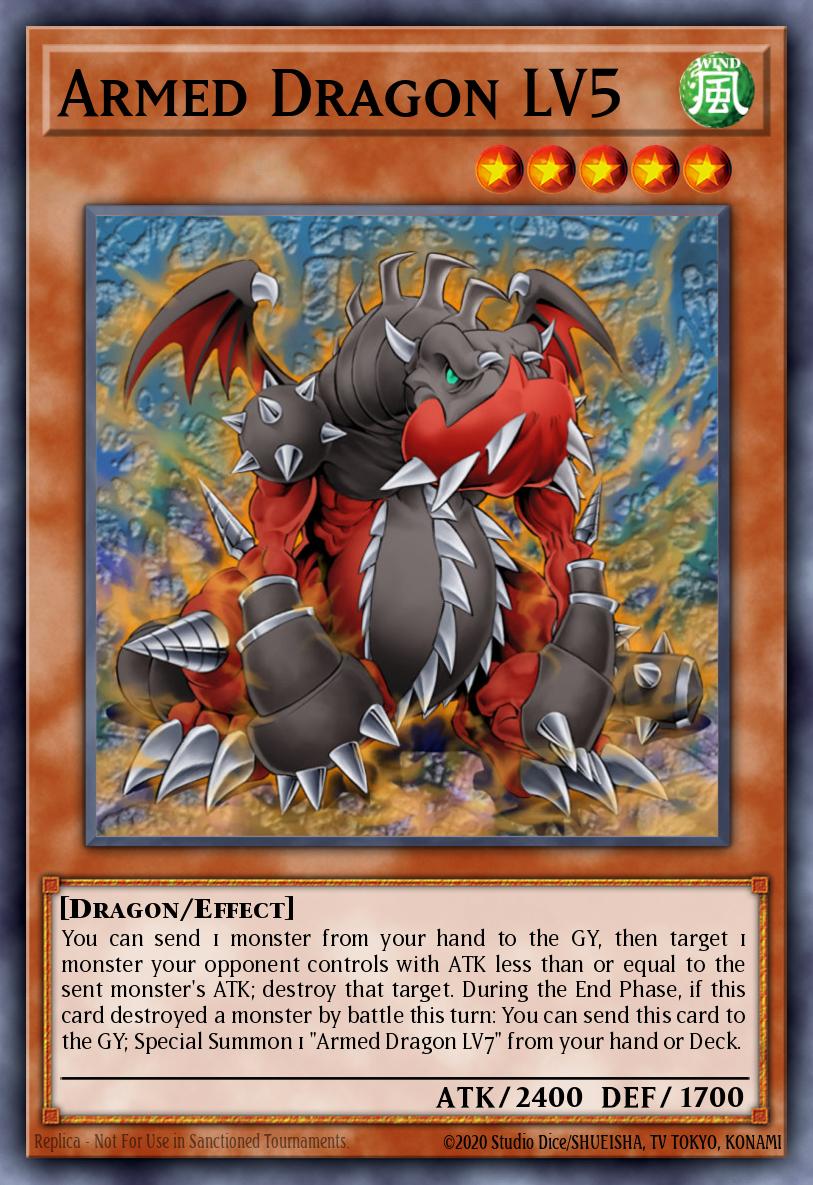


Card effects featured in this guide
English text from the card catalog. Check the in-game text for Duel Links specific adjustments.
Armed Dragon LV7
Cannot be Normal Summoned/Set. Must be Special Summoned by "Armed Dragon LV5". You can send 1 monster from your hand to the GY; destroy all monsters your opponent controls with ATK less than or equal to that sent monster's ATK.
Armed Dragon LV5
You can send 1 monster from your hand to the GY, then target 1 monster your opponent controls with ATK less than or equal to the sent monster's ATK; destroy that target. During the End Phase, if this card destroyed a monster by battle this turn: You can send this card to the GY; Special Summon 1 "Armed Dragon LV7" from your hand or Deck.
1. Use the original LV line
The original Armed Dragon LV5 and Armed Dragon LV7 use a specific Level-up route. Armed Dragon cards with Thunder in their names have different evolution effects, so do not treat those procedures as identical. For the classic LV5 route, destroy a monster by battle with LV5, keep it on the field until your End Phase, and have Armed Dragon LV7 available in your hand or Deck for the next step.
| Field | Value |
|---|---|
| Format | Duel Links Speed Duel |
| Character | Chazz Princeton |
| How to obtain | Armed Dragon LV7 is Chazz level 40 and listed at the Card Trader. |
2. An effect destruction spends a card for a different result
LV5 can send a monster from hand to the Graveyard to destroy a targeted opposing monster at or below that sent monster’s ATK. If you use that effect on the only possible battle victim, you may lose the End Phase progression. Lead with the effect when it clears a stronger threat and leaves a weaker remaining monster for LV5 to defeat in combat.
3. Take the End Phase decision deliberately
If LV5 destroyed a monster by battle, it can send itself to the Graveyard during your End Phase and bring out LV7 from your hand or Deck. LV7 arrives after your turn’s attacks. Weigh whether the jump to 2,800 ATK matters on the opponent’s turn and whether you can protect it until its own removal becomes relevant.
4. Choose the discard by the whole opposing field
LV7’s removal sends a monster from hand to the Graveyard and destroys opposing monsters at or below that monster’s ATK. For example, a 2,400 ATK hand monster covers opposing 1,600 and 2,400 ATK monsters, but a 2,600 ATK opponent remains. Estimate the number of threats you actually clear and whether you can deal with the survivor before giving up an important follow-up piece.
A face-down monster gives you no known ATK benchmark for this comparison. Before relying on a field sweep, have a battle or another approach for a hidden defender.
5. Protect the attack before the dragon
The vulnerable turn is often the one where LV5 needs its battle result. If an opposing set card can remove the attacker or alter the damage step, decide whether your available interaction can force it first. Keep a plan for an LV5 that ends the turn without upgrading, so the deck still has resources if the opponent stops the attack.
6. Record where the upgrade went missing
Practice once against a single blocker, once against two weaker monsters, and once against a stronger body plus a weak blocker. Note whether the wrong removal order, the lack of an LV7 copy, or failure to keep LV5 alive caused the miss. More copies of the boss solve only the second error, and they can replace useful starters in opening hands.