
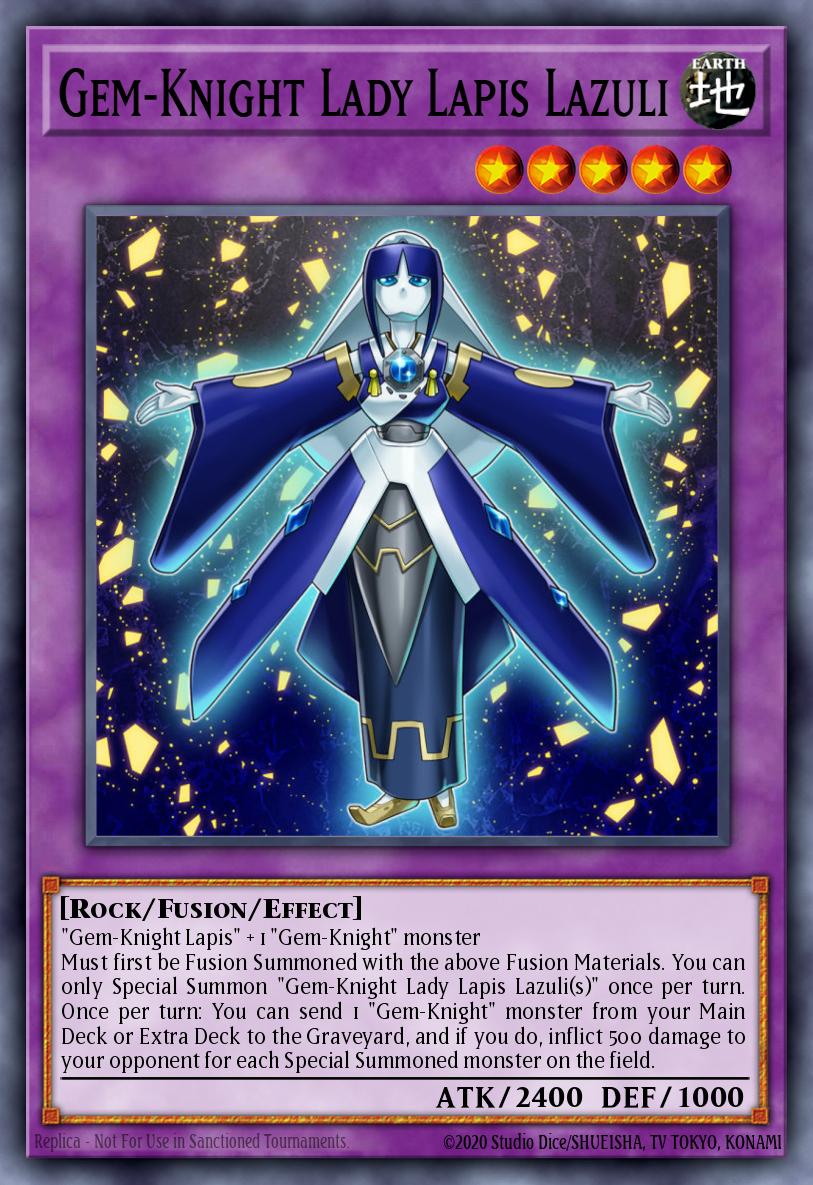


Can your Fusion board actually deal 8,000?
Gem-Knight can end a game with attacks plus effect damage, but the numbers depend on how each Fusion reached the field. Gem-Knight Master Diamond Dispersion can turn its own board slot into several new monsters to raise your damage ceiling. Both it and Gem-Knight Nepyrim joined Master Duel with Regeneration of Stars in September 2025. Before you build toward a one-turn finish, account for any direct-attack restriction and any reduction to effect damage your earlier cards imposed.
| Tool | Main use | Condition to track |
|---|---|---|
| Scatter Fusion | Fuse a non-Rock Gem-Knight using Deck materials | The opponent must control a monster |
| Phantom Quartz | Fuse from GY and banishment for 1,000 LP | The summoned Fusion cannot attack directly that turn |
| Master Diamond Dispersion | Swap itself for up to three non-Rock Gem monsters | Different names, and Fusion-only from the Extra Deck afterward |
Check Type and space before sending Dispersion away
Master Diamond Dispersion takes three Gem- monsters as Fusion material. In either Main Phase it can send itself from the field to the Graveyard and summon up to three differently named non-Rock Gem- monsters from the Extra Deck or Graveyard, ignoring their summon conditions. Count the legal names and the zones after Dispersion leaves. If you want the Rock-type Gem-Knight Lady Brilliant Diamond, reserve a different way to summon it.

Once Dispersion's effect resolves, any further Extra Deck summons that turn must be Fusions. Make Gem-Knight Phantom Quartz first if you need its Link Summon. If you also used Scatter Fusion, its own effect restricts later Extra Deck summons to Gem-Knight monsters. With both limits in place, your next Extra Deck monster needs to satisfy both restrictions.
Calculate the burn and the attacks separately
Gem-Knight Lady Lapis Lazuli deals 500 damage for each Special Summoned monster on either field when its effect resolves. With five such monsters, that is 2,500. Suppose the opponent has no blocker and both Lapis Lazuli at 2,400 ATK and Lady Brilliant Diamond at 3,400 ATK can attack directly. Their attacks add 5,800, giving 8,300 total. That calculation assumes both attacks are available and the effect damage goes through in full.
If the search from Nepyrim has already resolved, Main Phase effect damage is halved for the turn. In that same position the effect deals 1,250, taking the total down to 7,050. Phantom Quartz adds a different constraint. The monster summoned by its Fusion effect cannot attack directly that turn. If either restriction leaves you short, decide what board you can keep for the opponent's turn.
Choose what to banish when recovering Gem-Knight Fusion
Gem-Knight Fusion can add itself back to the hand if you banish a Gem-Knight monster from your Graveyard. A suitable face-up banished monster can still be material for Phantom Quartz, which shuffles materials back from the Graveyard or banishment. Dispersion can summon only from the Extra Deck or Graveyard, so recovering the Spell can remove a monster you wanted for that effect. Choose the banish based on which summon you still need.
Vejeya's September 21, 2026 Master I submission gives you a dated build to adapt. With an opposing monster on the field, Scatter Fusion can open a route using materials from the Deck. If your first Fusion is stopped, work out what you can still summon and whether the remaining attack and effect damage can end the game. That will tell you which missing Spell or Extra Deck monster changes the play you can actually make.